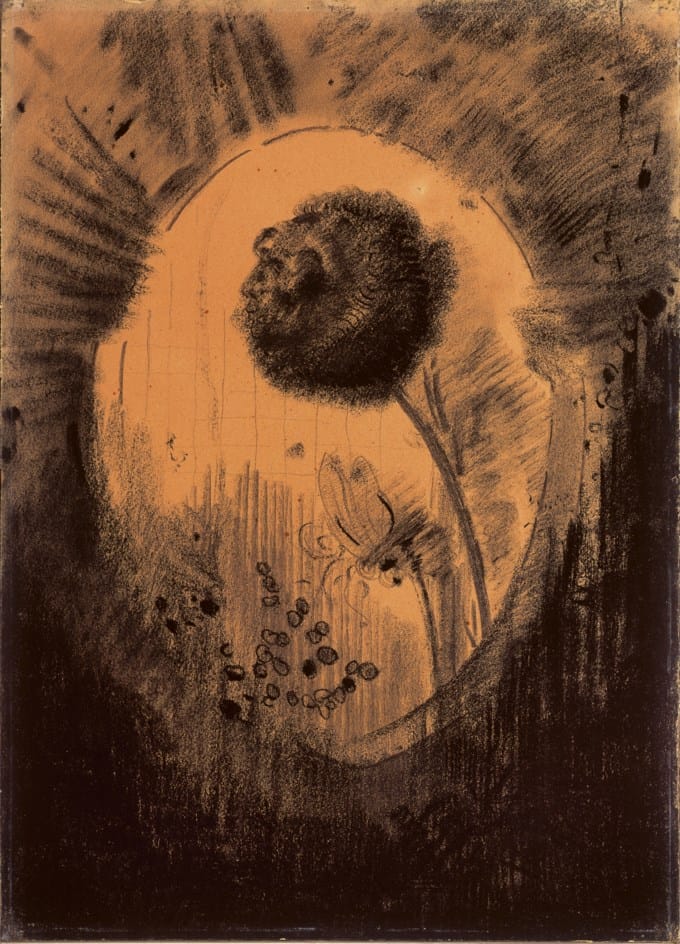
Title: Il y a peut-être une première humanité essayée dans la fleur
Artist: Odilon Redon (French, 1840-1916)
Medium: fusain et mine de plomb on papier
Dimensions: 52.2 x 37.9 cm
Date Created: 1890
Description
Odilon Redon, the undisputed master of fantastical imagery, elevated charcoal drawing to a position of nobility within the European Symbolist movement. His “noirs,” as he termed them, dominated his output from the 1870s to the 1890s. During this period, he also dedicated himself to lithography, primarily in black and white, producing several albums that compiled his visionary works, deeply imbued with inquiries into life’s mystery.
“Maybe There is a First Humanity Tried in the Flower” encapsulates the poetry of Redon’s spiritualist and mythic thought. Inspired by Edgar Allan Poe’s writings, Redon was among the first to explore the subconscious mind’s labyrinth, obsessively cultivating his intimate visions through art. He transformed personal anguish into a fertile source of imagination. The work depicts a strange flower isolated within a halo of insolent brightness. The profound black surrounding it accentuates the almost monstrous protrusion of the blossoming petals and pistils, from which the head of a primitive man seems to emerge. This near-Christlike staging may evoke the radiance of a saintly icon within its nimbus. Perfectly fantastical, it is also one of those Baudelairian “flowers of evil,” both venomous and captivating, blending reality with the sublime. Redon was a sophisticated connoisseur of botanical science, introduced to it by his friend Armand Clavaud. Clavaud’s suicide in 1890 profoundly marked the painter, who dedicated his 1891 album “Les Songes” to his departed friend.
Image Download
Image Dimensions: 2000 x 2777 pixels
Image Size: 2.9 MB
Image Format: JPG
Print Resolution: 300 dpi
Download Format: ZIP Archive
License: Public Domain, Free for Commercial Use