Title: Quasimodo
Artist: Odilon Redon (French, 1840-1916)
Medium: charcoal, white chalk and white heightening on paper
Dimensions: 36.8 x 32.9 cm
Date Created: circa 1875-1880
Description
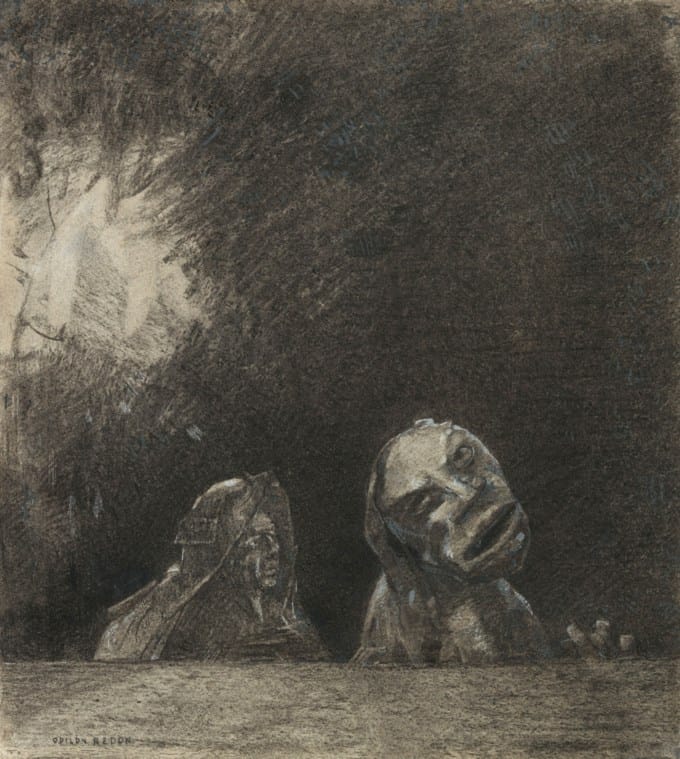
Quasimodo stands as an emblematic work from Odilon Redon’s noir period, created between 1870 and 1890 when the artist worked almost exclusively in neutral tones, primarily using rich black charcoal. Employing erasures and white heightening, Redon achieved a dramatic chiaroscuro effect. A Romantic in spirit, he drew profound inspiration from Francisco Goya, particularly the latter’s black paintings. For Redon, black pigment was a medium to explore the realm of shadows, indulging his fascination with the phantoms of insomnia and nightmares—the darker imaginings that take form at night.
The subject references the twisted protagonist of Victor Hugo’s The Hunchback of Notre-Dame, a seminal literary work published roughly forty years prior. Both Redon and Hugo were categorized as “Baudelaire Romanticists,” a lineage tracing to Charles Baudelaire, the poet, translator of Edgar Allan Poe, and critic who championed artists like Delacroix. While Redon’s noirs align with this darker Romantic aesthetic, they also possess a deeply personal, whimsical quality that would later inspire the Surrealists.
The figure in Quasimodo does not strictly adhere to Hugo’s description; it is not an illustration but Redon’s own personification of the iconic outcast. The face and modeling echo the ghoul-like forms recurring in his work of this period, often dedicated to Romantic luminaries like Poe and Goya. This drawing is a singular testament to Redon’s engagement with his influences and the continuum of creative thought.
Image Download
Image Dimensions: 2868 x 3200 pixels
Image Size: 1.58 MB
Image Format: JPG
Print Resolution: 300 dpi
Download Format: ZIP Archive
License: Public Domain, Free for Commercial Use