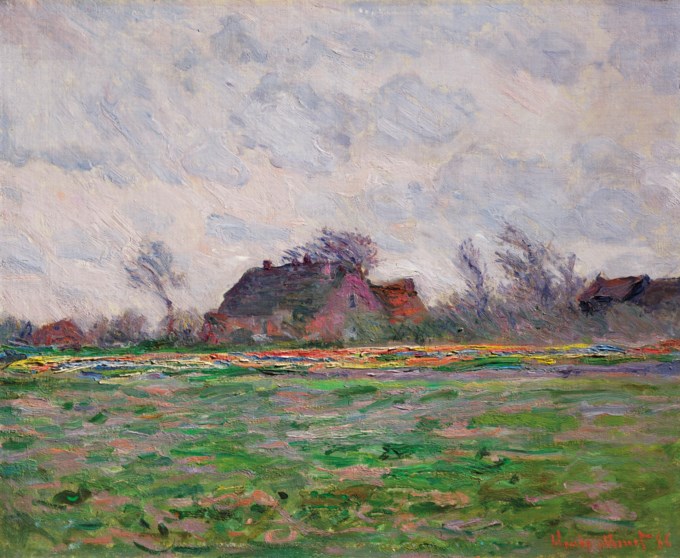
Title: Champ de tulipes près de Leyde
Artist: Claude Monet (French, 1840-1926)
Medium: oil on canvas
Dimensions: 60 x 73.3 cm
Date Created: 1886
Description
On April 27, 1886, Claude Monet departed Paris for Holland at the invitation of Baron d’Estournelles de Constant, a future Nobel laureate and ardent admirer of his work. The Baron sought to introduce the artist to the spectacular chromatic displays of the country’s famed tulip fields. Though the sojourn lasted just over a week, Monet produced five paintings of the blooming fields around Sassenheim. Among this small series, Champ de tulipes près de Leyde remains the only work in private hands; the others reside in major international museums, including the Musée d’Orsay and the Clark Art Institute.
This trip aligned with Monet’s 1880s practice of traveling to refresh his vision. He often left Giverny for weeks to paint along the Normandy coast, the Italian Riviera, or Belle-Île, seeking new motifs. The Hague visit, brief as it was, fulfilled that desire—while Monet had visited Holland twice before, this marked his first attempt to paint the annual tulip spectacle.
In a letter to Théodore Duret, Monet described the “wide fields in full bloom” whose radiant beauty could “drive the poor painter mad.” He doubted whether modern pigments could capture the tulips’ explosive glow. In Champ de tulipes près de Leyde, Monet confronts this challenge directly. The painting depicts a windy, cloud-swept day, with trees bending along the horizon. Unlike its companion piece, the foreground canal is omitted, focusing instead on the varied grasses and foliage rendered with sumptuous, overlapping strokes that convey the wind’s movement.
Image Download
Image Dimensions: 3200 x 2627 pixels
Image Size: 3.35 MB
Image Format: JPG
Print Resolution: 300 dpi
Download Format: ZIP Archive
License: Public Domain, Free for Commercial Use