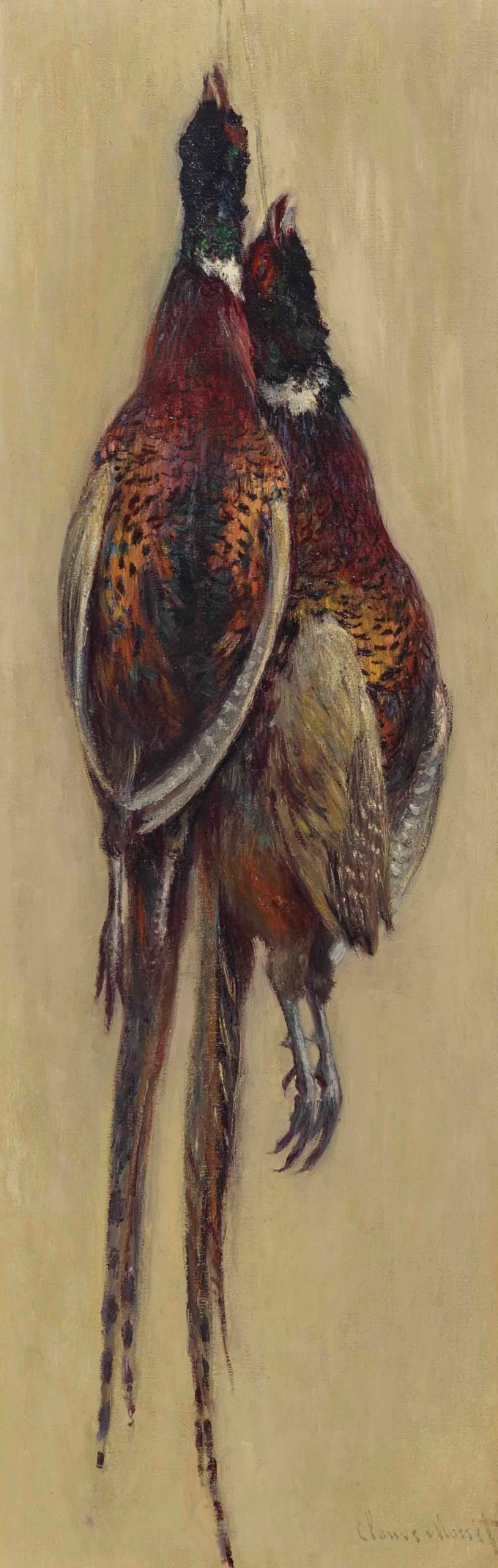
Title: Faisans suspendus
Artist: Claude Monet (French, 1840-1926)
Medium: oil on canvas
Dimensions: 114.4 x 38.2 cm
Date Created: 1882
Description
Although Monet worked intermittently in still life throughout his long career, his achievement in the genre is widely acknowledged. Faisans suspendus is the final work from a series of game bird compositions painted between 1879 and 1882, a period that yielded the highest number of still-life works in his oeuvre, exhibited in both Impressionist shows and his solo exhibitions.
Historically relegated within the academic hierarchy for its perceived lack of inventive composition compared to history painting, still life gained significant critical and public popularity by the mid-19th century. A revived interest in the 18th-century master Jean-Baptiste-Siméon Chardin, cemented by museum acquisitions, scholarly publications, and major exhibitions, repositioned him as France’s preeminent still-life painter. These developments, occurring during Monet’s formative years, established Chardin as “the great touchstone for contemporary still life” for Monet and his circle.
Beyond aesthetic engagement, Monet’s focus on still life in the late 1870s and early 1880s was partly commercially motivated. During financial strain, his depictions of fruit and hunting trophies sold more readily and for higher prices than his landscapes. As scholar Charles Stuckey noted, “Financially speaking, landscape painter Monet was saved by his work in still-life.”
An earlier series work, Faisans et vanneaux, was shown in Monet’s first solo exhibition (1880) and the seventh Impressionist exhibition (1882). The present work featured in a solo show organized by his dealer Paul Durand-Ruel in March 1883, which included eleven still-life paintings. By promoting these works, Monet consciously situated himself within the 18th-century still-life tradition, enhancing their appeal to collectors. Yet he did not merely replicate past models. Art historian John House observed that Monet’s still lifes around 1880 “systematically undermined the conventions of the then-dominant Chardin tradition… Monet played down the physicality of the objects in favor of emphasizing their optical effect, with the informality of their grouping suggesting that this effect has been rapidly perceived, rather than carefully ordered.”
Image Download
Image Dimensions: 1016 x 3200 pixels
Image Size: 196 KB
Image Format: JPG
Print Resolution: 300 dpi
Download Format: ZIP Archive
License: Public Domain, Free for Commercial Use