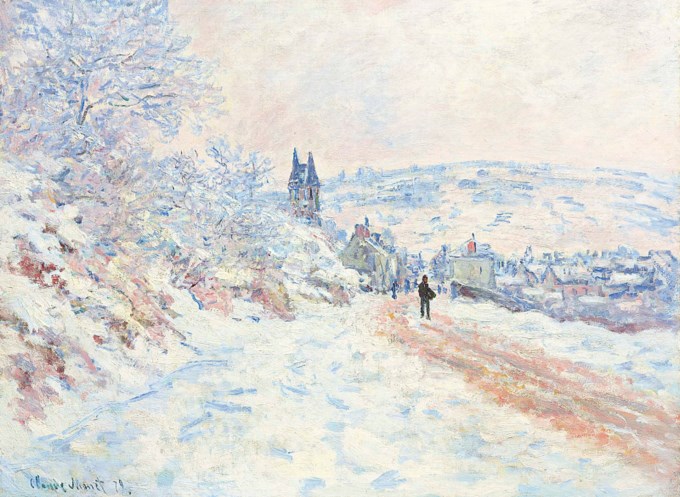
Title: La route de Vétheuil, effet de neige
Artist: Claude Monet (French, 1840-1926)
Medium: oil on canvas
Dimensions: 61.1 x 81.1 cm
Date Created: 1879
Description
In 1879, his first full year residing in the rural hamlet of Vétheuil, Claude Monet captured this exquisitely subtle view of the village under a heavy snowfall. Painted from the road to La Roche-Guyon, the composition looks back toward Vétheuil, where his rented home sits beneath the twin turrets of his landlady’s villa. This canvas is the first of three from a similar vantage point, documenting the transient winter landscape—here, snow still blankets the scene beneath a white sky heavy with the promise of another storm, while later versions show the thaw beginning.
Monet described the fresh snow with a muted symphony of whites, flecked with silver, blue, and violet. A track rendered in reddish-ochre provides the sole warm contrast. The road curves in from the lower right, drawing the viewer into the frozen quiet. Foliage in the immediate foreground accentuates spatial recession, while houses spread horizontally in the middle distance, and the snow-covered mass of the Chênay hill rises beyond.
Where the road enters the village and disappears, a single black-clad figure trudges through the snow—the only movement in the scene, perhaps a proxy for the artist himself advancing toward his motif. This embodies a central Impressionist tenet: the painter before nature, transcribing immediate sensation. A contemporary journalist once described encountering Monet in such bitter cold, bundled in three coats with half-frozen face, “studying an effect of snow.”
Monet’s three years at Vétheuil (1878–1881) marked a decisive artistic reassessment. Leaving behind scenes of modern life, he turned toward fugitive aspects of nature, developing a nascent serial technique that would ground his later work. Despite personal hardships—his wife Camille’s fatal illness and dire finances—Vétheuil became a crucible for renewal.
Though signed “1879,” the painting’s exact timing is debated. The winter was exceptionally severe, with deep snows from late November isolating the village. This frigid weather kept most indoors, allowing Monet to work undisturbed. The stillness of winter offered both respite from worldly cares and, poignantly, a visual metaphor for loss and transition.
The work stands as a testament to a period of profound change. The solitary figure, the silent village, the laden sky—all speak to impermanence and contemplation, solitude and pursuit.
Image Download
Image Dimensions: 3200 x 2340 pixels
Image Size: 930 KB
Image Format: JPG
Print Resolution: 300 dpi
Download Format: ZIP Archive
License: Public Domain, Free for Commercial Use