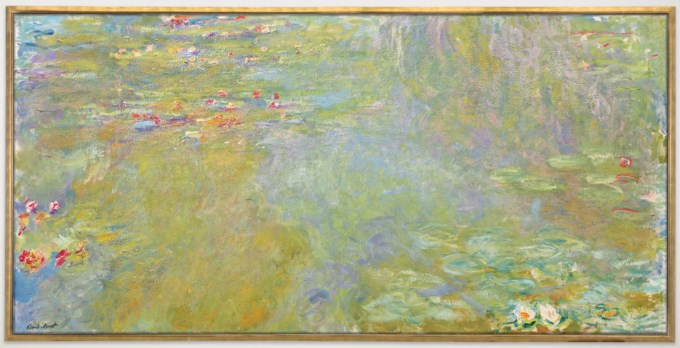
Title: Le bassin aux nymphéas
Artist: Claude Monet (French, 1840-1926)
Medium: oil on canvas
Dimensions: 100.7 x 200.8 cm
Date Created: 1917-1919
Description
In the summer of 1918, as the Great War reached its climax, Monet commenced this Bassin aux nymphéas. The painting transforms his Giverny pond into a meditative sanctuary. Lily pads gather at the canvas edges, framing a central cascade of light—a motif evolved from his 1907 series, now rendered with ethereal transparency. Delicate veils of color dissolve boundaries between water and sky, creating an immersive, boundless space.
Monet conceived these works as a tribute to peace. The day after the Armistice, he wrote to Prime Minister Clemenceau offering decorative panels to the state, declaring this his “only way of taking part in the victory.” This painting belongs to a cohesive series of fourteen works on elongated canvases (1×2 meters), which served as precursors to his monumental Grandes Décorations. When dealer René Gimpel visited, Monet arranged them in a circle on the floor, evoking the pond’s endless horizon: “It was as though we were present at one of the first hours of the birth of the world.”
Created during the war’s decisive turn, these works embody resilience. With German forces advancing near Giverny in early 1918, Monet vowed to remain “in the middle of what I have done.” By autumn, Allied victories inspired him to dedicate his final years to the vast water lily murals for the Orangerie. This canvas, a finished masterpiece from that pivotal moment, captures timeless serenity amidst upheaval, affirming art’s capacity to transcend its epoch.
Image Download
Image Dimensions: 3200 x 1636 pixels
Image Size: 1.02 MB
Image Format: JPG
Print Resolution: 300 dpi
Download Format: ZIP Archive
License: Public Domain, Free for Commercial Use