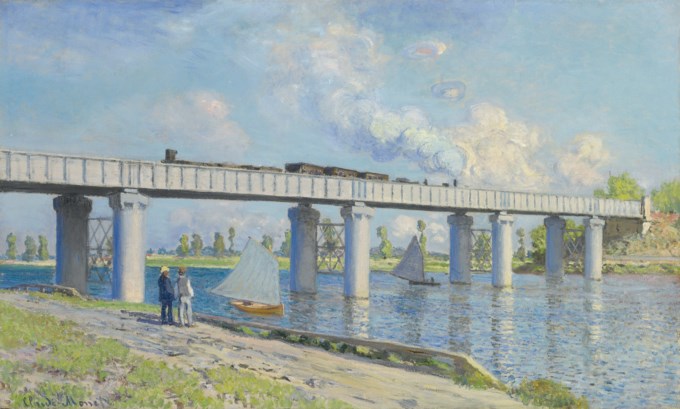
Title: Le Pont du chemin de fer à Argenteuil
Artist: Claude Monet (French, 1840-1926)
Medium: oil on canvas
Dimensions: 60 x 98.4 cm
Date Created: 1873
Description
Monet’s Argenteuil landscapes of the 1870s stand as a pinnacle of Impressionism. The suburban town, rebuilt after the Franco-Prussian War, became a microcosm of modern life. Between 1871 and 1878, Monet produced over a hundred works here, with his railway bridge series being particularly definitive.
“Le Pont du Chemin de Fer,” painted in 1873, is the earliest, largest, and most audacious of five treatments of this subject. The newly reconstructed bridge, with its concrete piers and iron trestle, gleams under the afternoon sun. Two trains pass each other above, while two sailboats glide beneath the span. A stark dialogue emerges between industrial rigor and natural fluidity.
More than an engineering marvel, the bridge serves as a symbol of its era. Destroyed during the war, it is reborn in Monet’s vision as a potent metaphor for national renewal. The artist deliberately crops out factories and warehouses, distilling the structure into a pure icon of modernity. Its horizontal line redraws the horizon; two small figures on the bank gaze upward, dwarfed by the technological sublime.
Monet confronts modernity with frank celebration, yet imbues the scene with poetry. The train’s smoke merges with clouds, and the sails of the boats echo the bridge’s geometric piers. This painting is not merely a paean to industry; it reveals a nascent symbiosis between leisure and progress. With its radical composition and theme, it established a lasting precedent for depicting the modern landscape.
Image Download
Image Dimensions: 4790 x 2883 pixels
Image Size: 7.35 MB
Image Format: JPG
Print Resolution: 300 dpi
Download Format: ZIP Archive
License: Public Domain, Free for Commercial Use