Title: L’église de Vernon
Artist: Claude Monet (French, 1840-1926)
Medium: oil on canvas
Dimensions: 65 x 81.4 cm
Date Created: 1883
Description
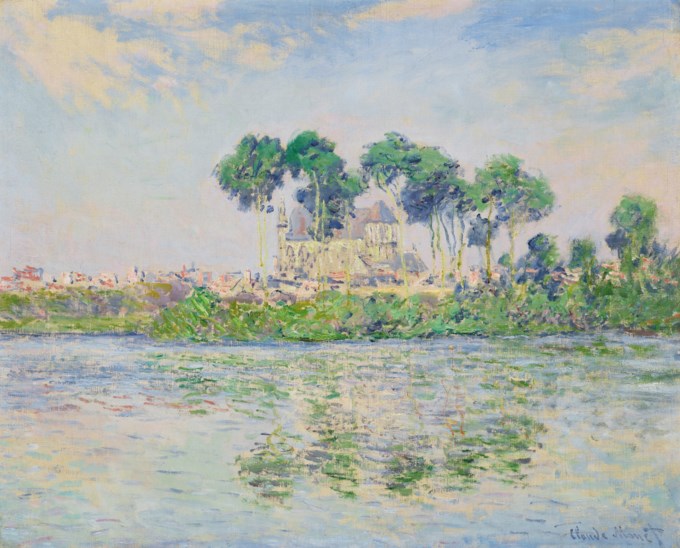
“The silhouette of the church in Vernon was so remarkable I had to paint it,” Monet recalled years later. It was early summer, with raw, foggy mornings giving way to sudden sunshine that slowly dissolved the mists, enveloping the golden stones in an ideal vapor. In late April 1883, Monet settled in Giverny with his family, in a pink stucco house mere meters from the Seine. “Once settled, I hope to produce masterpieces,” he wrote in May, “for I love the countryside very much.”
That first year, the Seine was his sole motif. From June until frost, he set his easel in the meadows at Vernonnet, looking diagonally across the river toward Vernon and its Gothic church. The ancient structure was partly veiled by poplars on Île Corday. The sun-dappled river, dancing with fragmented reflections, fills the foreground, the grassy bank stretching horizontally, emphasizing the water’s mirror-like quality. “The landscape, shimmering in iridescent light, was constantly changing,” wrote Daniel Wildenstein. “It was Impressionism at its purest, instantaneous and forever new.”
Monet reached the site by studio boat, moored near the confluence of the Epte and Seine. “Drifting down the quiet river, he watched with a hunter’s concentration for the precise moment light shimmered on grass or water,” described Andrew Forge. Here, the late morning sun illuminates the church’s chevet and tower, the bright light dematerializing the stone, making it as ephemeral as its reflection. The poplar screen merges architecture with nature. “Monet emphasizes nature’s wonders, whose light and atmosphere invade the façade. It is nature, and his ability to translate it, that triumphs,” noted Paul Tucker.
Image Download
Image Dimensions: 3200 x 2578 pixels
Image Size: 3.4 MB
Image Format: JPG
Print Resolution: 300 dpi
Download Format: ZIP Archive
License: Public Domain, Free for Commercial Use