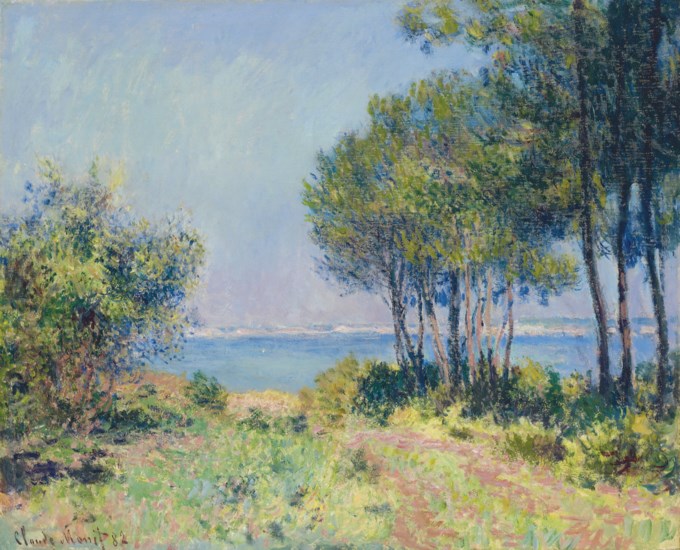
Title: Les sapins à Varengeville
Artist: Claude Monet (French, 1840-1926)
Medium: oil on canvas
Dimensions: 60 x 73.5 cm
Date Created: 1882
Description
Painted in 1882, Les sapins à Varengeville captures a serene, transient moment by Claude Monet, stemming from a sustained period of pictorial exploration. In the early 1880s, Monet turned to the Normandy coast, his childhood region, producing a dazzling array of seascapes.
This work coincides with a pivotal shift in Monet’s life. The evolution of his relationship with Alice Hoschedé and improved finances following sales to dealer Paul Durand-Ruel infused his art with renewed liberty and purpose. In February 1882, he discovered Pourville and nearby Varengeville, captivated by the quiet fishing village. He settled there, exploring and painting the surroundings, resulting in several celebrated views of Varengeville.
The painting exemplifies Monet’s increasingly refined aesthetic during this period. It pares away the superfluous, focusing on the essential dialogue between pine trees and sea. The pines create a rhythmic progression across the canvas, their forms filtering the rich blue of the water beneath dappled sunlight. Deliberately omitting any human presence or habitation, the scene breathes with the pure sensation of nature—only sky, trees, and sea remain. This masterful translation of outdoor atmosphere epitomizes the core of Impressionist landscape painting and Monet’s own practice.
The deft rendering of sun and warmth here also reflects Monet’s acute sensitivity to changing weather. His letters from Pourville oscillated between ecstasy over fine conditions and despair at rain, a mood dictated by painting’s necessities. That sensibility is distilled into this luminous study of light.
Image Download
Image Dimensions: 3753 x 3037 pixels
Image Size: 3.83 MB
Image Format: JPG
Print Resolution: 300 dpi
Download Format: ZIP Archive
License: Public Domain, Free for Commercial Use