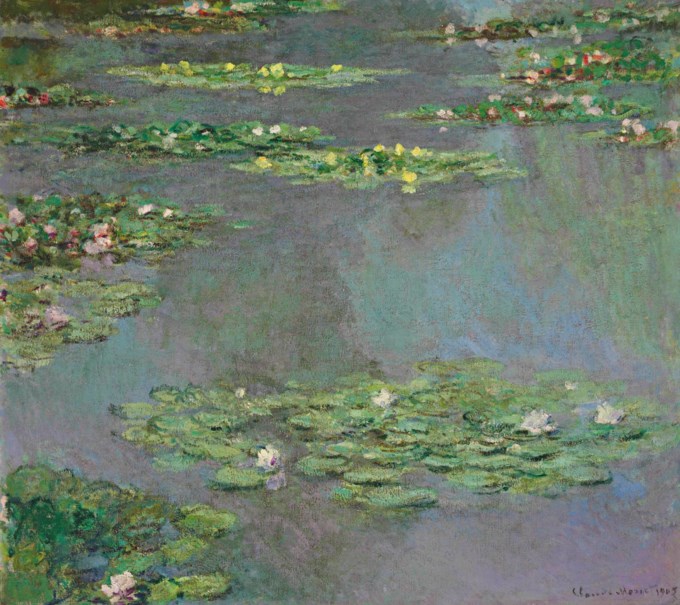
Title: Nymphéas
Artist: Claude Monet (French, 1840-1926)
Medium: oil on canvas
Dimensions: 88.3 x 99.5 cm
Date Created: 1905
Description
While gardens captivated many Impressionists, Claude Monet’s devotion to the theme was unparalleled. He once credited flowers for making him a painter. His garden at Giverny, especially the water lily pond he created, became the central obsession of his later years. Over the final two decades of his life, Monet dedicated himself almost exclusively to depicting this pond, producing a revolutionary series of more than two hundred canvases that rank among his most innovative works.
In 1893, Monet acquired land at Giverny to excavate a pond, divert water, plant water lilies, and build a Japanese footbridge. This silent, contemplative water garden stood in contrast to the formal flowerbeds near his house. He conceived it both “for the pleasure of the eyes” and as a source of subjects to paint. Initial depictions included the bridge, but after 1904, the water’s surface itself became his near-exclusive motif. Gradually, he eliminated all spatial anchors like the horizon or banks, immersing the viewer in a destabilized world of light, color, and reflection.
Between 1905 and 1908, Monet entered an intensely productive phase, completing over sixty views of the pond. This work dates from that period. He repeatedly postponed exhibitions, driven to continue his exploration. Within his self-imposed compositional scheme, he devised dazzling variations—rearranging blossoms, modulating reflections, and capturing fleeting light effects. This painting belongs to an important 1905-1907 subgroup characterized by horizontal bands of lilies juxtaposed with vertical, shimmering reflections of trees and sky. Impasto flowers assert their tangible presence, while thinly layered washes suggest depth and refraction. Each canvas resisted duplication.
In May 1909, Monet exhibited forty-eight water lily paintings at Galerie Durand-Ruel to critical acclaim. One reviewer compared the series to Michelangelo’s Sistine ceiling. Exhausted and beset by personal tragedies, Monet painted little for nearly five years after the show. He resumed work in earnest in 1914, producing over a hundred more pond views during his final twelve years, most kept in his studio. The culmination was the Grandes Décorations, monumental murals donated to France and installed in the Musée de l’Orangerie after his death.
Image Download
Image Dimensions: 3200 x 2847 pixels
Image Size: 912 KB
Image Format: JPG
Print Resolution: 300 dpi
Download Format: ZIP Archive
License: Public Domain, Free for Commercial Use