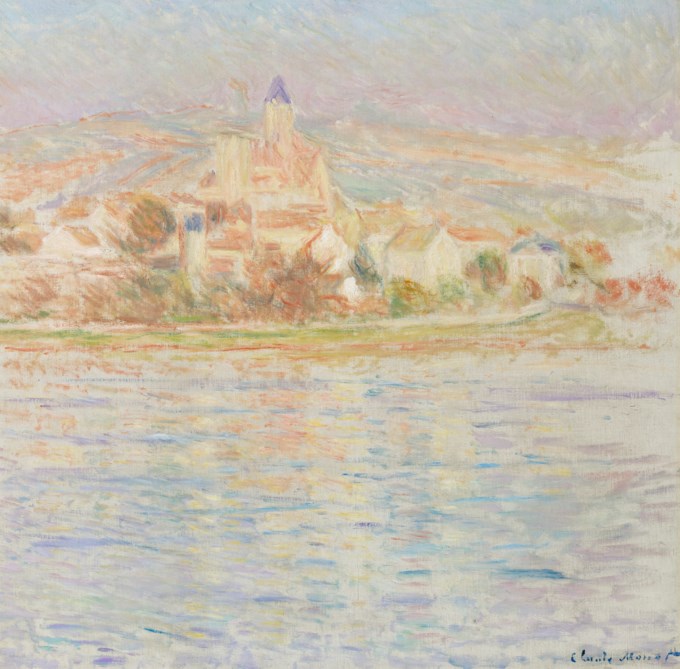
Title: Vétheuil
Artist: Claude Monet (French, 1840-1926)
Medium: oil on canvas
Dimensions: 89.5 x 92.5 cm
Date Created: circa 1901-1902
Description
In the sweltering summer of 1901, confined by renovations at Giverny, Claude Monet sought refuge in the familiar landscape of Lavacourt. Renting a modest house overlooking the Seine, he turned his gaze daily toward the opposite bank and the village of Vétheuil—a place laden with personal history from his earlier years. This painting belongs to a pivotal series of fifteen works begun that season, capturing the hamlet in its enduring, pre-modern serenity.
Vétheuil remained an agrarian idyll, untouched by bridges or railways, its heart crowned by the Romanesque church of Notre-Dame. Monet, who had once called it “a ravishing spot,” now engaged it through his mature serial practice. Stationed at his window, he studied the transient effects of light and weather, rendering the scene in the soft glow of morning, the haze of dusk, or under gathering clouds. Each canvas shares an identical viewpoint and near-square format, with the village clustered in the upper third above the expansive, reflective Seine.
Here, Monet’s handling is notably spontaneous. Loose, light strokes skim the surface, leaving areas of bare canvas at the edges—a testament to his confident, rapid execution. Delicate brushwork and subtle tonal transitions dissolve boundaries between shore and river, hill and sky. The water shimmers with short, horizontal touches that evoke the gentle flow of the current. Of the series, seven paintings reside in major museums worldwide, including the Musée d’Orsay and The Art Institute of Chicago. This work remained in Monet’s personal collection until his death.
Image Download
Image Dimensions: 3200 x 3149 pixels
Image Size: 3.94 MB
Image Format: JPG
Print Resolution: 300 dpi
Download Format: ZIP Archive
License: Public Domain, Free for Commercial Use