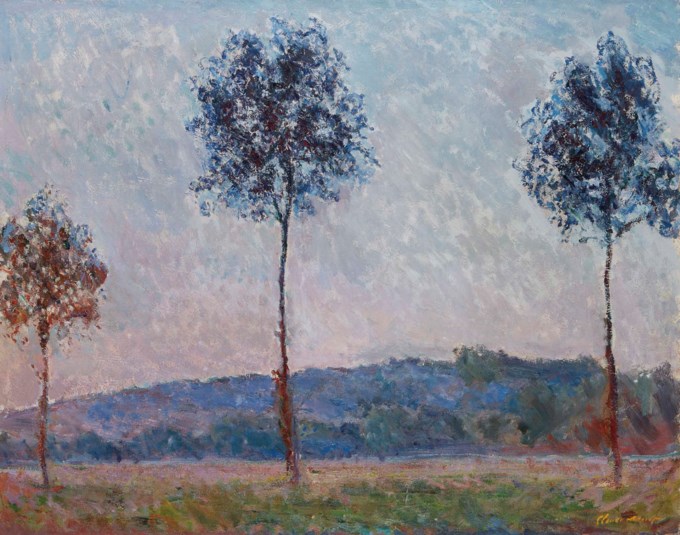
Title: Trois arbres à Giverny (Peupliers)
Artist: Claude Monet (French, 1840-1926)
Medium: oil on canvas
Dimensions: 73.1 x 92.4 cm
Date Created: 1887
Description
The landscape at Giverny held Monet in thrall. He would explore for hours, over hills and through valleys, in marshes and meadows, among streams and poplars. Drifting down the quiet river in his boat, he watched with a hunter’s concentration for the precise moment when light shimmered on grass, on silver willow leaves, or on the water’s surface. His motif would reveal itself, suddenly or by degrees.
Trois arbres à Giverny, painted in the lush countryside near Jeufosse or Vernonnet hill during 1887-1888, is a stunning example of Monet’s prairie scenes that celebrate the subtle light and vibrant colors of spring. Three related sketches reside at the Musée Marmottan Monet in Paris, testament to his passion for capturing the landscape’s ever-changing moods under shifting skies.
The work embodies central tenets of Monet’s practice: an unwavering dedication to painting en plein air. Immersed daily in the landscape, he meticulously observed the minute, imperceptible changes in light wrought by season, weather, and time. Painting directly before his subject, the resulting canvas is a nuanced vision of a singular, fleeting moment.
Here, the majesty of the poplars is enhanced by the contrast between their verticality and the meadow’s horizontality. Monet focuses on surface and the interplay of color within their forms, capturing their visual dominance. A diverse array of tones—from a rose-tinted haze cutting across the sky to a mosaic of deep blue, gold, green, and red filling the meadow—conveys the rich, ephemeral play of morning light upon the trees and their surroundings.
The poplar was a deeply French subject, a common feature of the countryside used for demarcation and riverbank reinforcement. Following the Revolution, its etymology (from Latin populous, meaning ‘people’ and ‘popular’) transformed it into a symbol of liberty, equality, and fraternity—l’arbre de la liberté. A critic noted in 1889: “Monet understood the poplar, which summarizes all the grace, all the spirit, all the youth of our land.” Furthermore, the composition’s tight framing and limited depth share a strong affinity with the prints of Hiroshige and Hokusai, whose works Monet collected and which may have inspired a new way of seeing the landscape.
Image Download
Image Dimensions: 3200 x 2518 pixels
Image Size: 675 KB
Image Format: JPG
Print Resolution: 300 dpi
Download Format: ZIP Archive
License: Public Domain, Free for Commercial Use